“Keep it simple” is one of the most common rules for business presentations.
In many European companies, good slides are expected to be visually clean, highly condensed, and limited to a few key messages. The presenter provides the context while the slides support the spoken explanation. But does the same approach work when presenting to Japanese business partners?
Not always.
Japanese business presentations often contain more information per slide than European presentations. To European eyes, they may initially appear detailed, colorful, or even overloaded. However, this does not necessarily mean that the presentation has been poorly designed. It often reflects a different purpose.
A presentation may have to work without the presenter
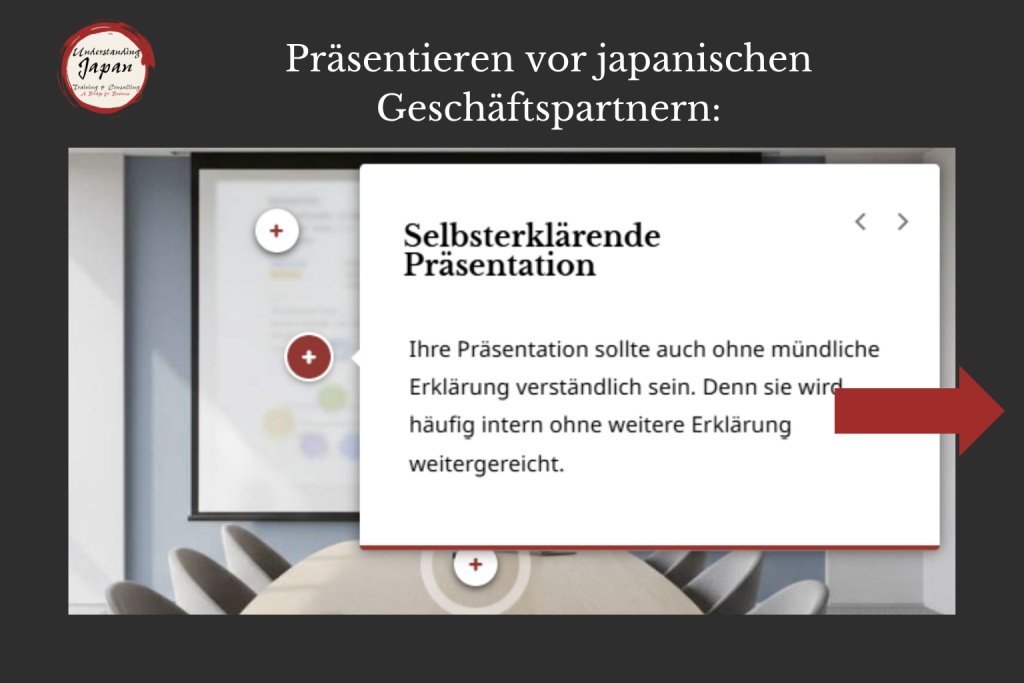
When preparing a presentation for Japanese stakeholders, it is important to consider what will happen to the material after the meeting. Your slides may be shared with colleagues, technical specialists, managers, or senior decision-makers who were not present during the original presentation. These people will not hear your explanations or have the opportunity to ask questions. The presentation therefore needs to be understandable on its own.
Before sending your slides, ask yourself:
-
- Can someone who did not attend the meeting understand the main message?
-
- Are the relevant assumptions and background information included?
-
- Are technical terms and abbreviations explained?
-
- Is it clear what you are proposing and what should happen next?
A highly visual slide with only three keywords may work well during a live presentation. It may be much less useful when circulated internally several days later.
Six aspects to consider
1. Information density
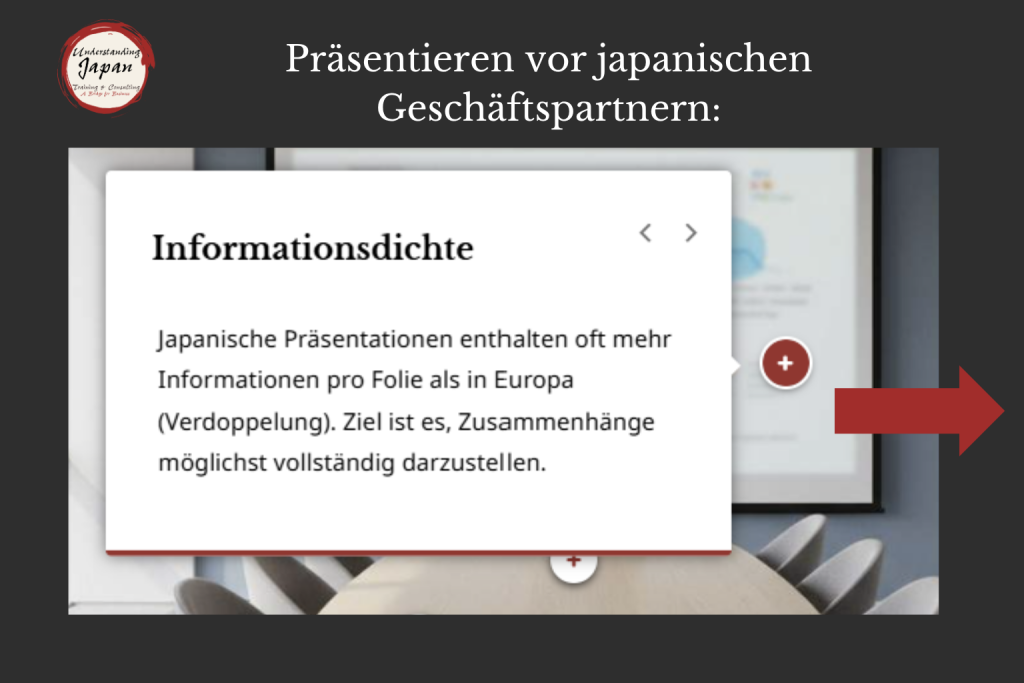
Japanese presentations often contain more information per slide than presentations in Europe or North America. The objective is not simply to add as much text as possible. The additional information should help readers understand the context, identify relevant connections, and answer questions that may arise during internal discussions. Consider including short explanations, relevant background information, and supporting details—but organize them carefully.
2. Processes and responsibilities
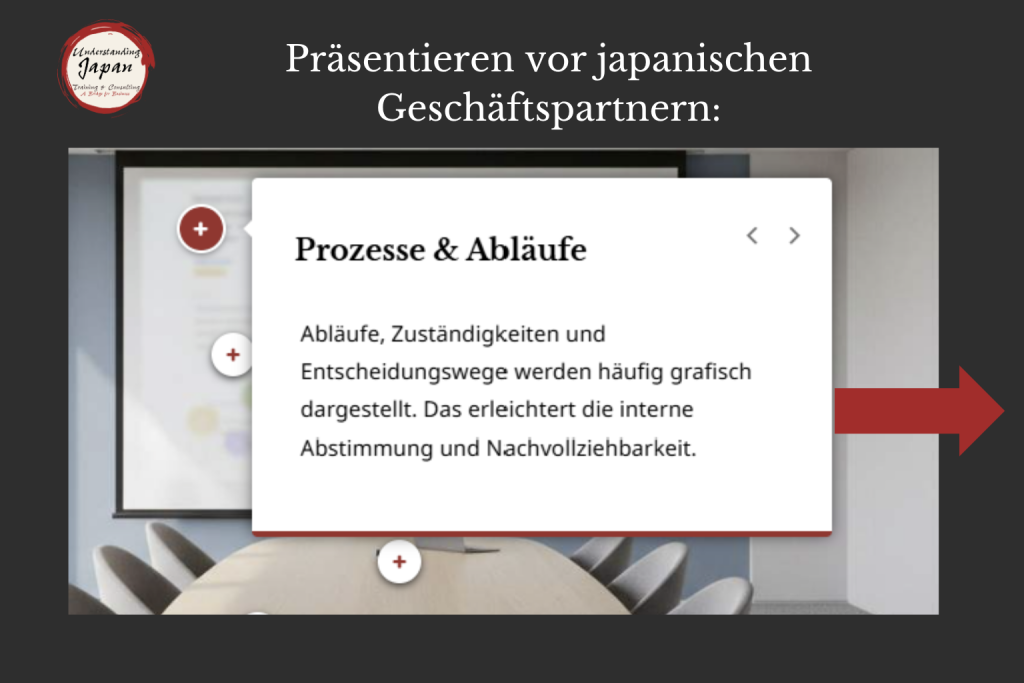
Visualizing processes can be particularly helpful. Flowcharts, timelines, organizational structures, and responsibility matrices make it easier to understand:
-
- how a proposed process will work,
-
- which department is responsible for each step,
-
- where decisions need to be made,
-
- and how the Japanese organization will be involved.
This supports internal coordination and reduces ambiguity. Do not assume that everyone shares the same understanding of the proposed workflow simply because it was discussed during the meeting.
3. Colors and visual markers
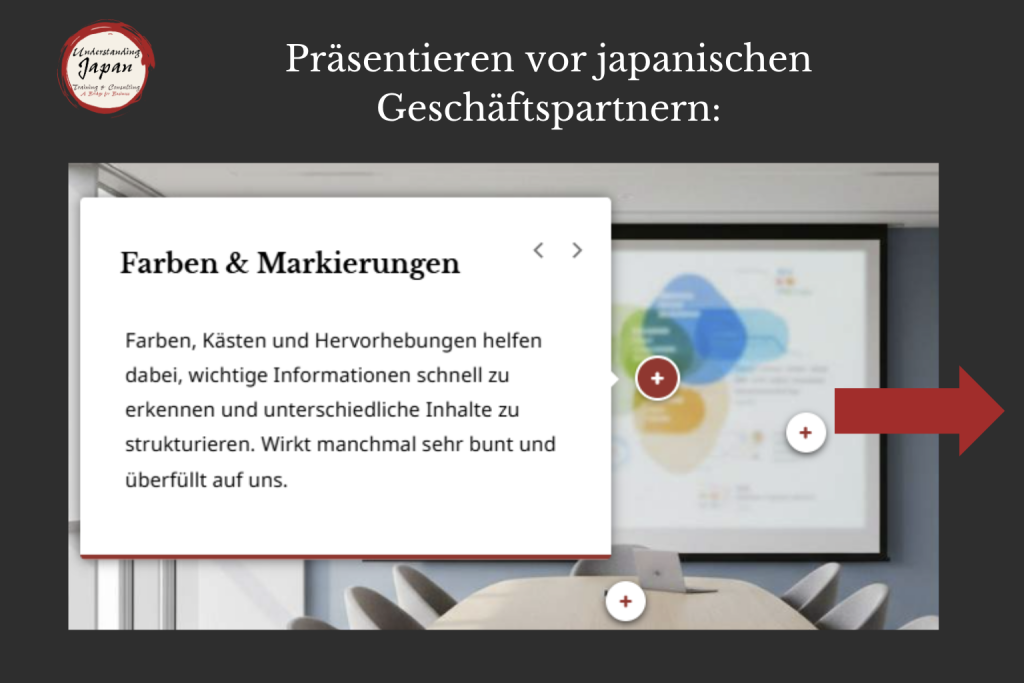
Colors, boxes, arrows, and other forms of highlighting are often used to distinguish between different types of information. A presentation may consequently appear more colorful than the minimalist designs common in many European companies. Nevertheless, visual markers can help readers recognize priorities, responsibilities, risks, or changes quickly. The key is consistency. Each color and symbol should have a clear meaning and should be used in the same way throughout the presentation.
4. Data and facts
General claims may not be sufficient to convince Japanese stakeholders, particularly in technical or risk-sensitive environments. Whenever possible, support your statements with concrete information:
-
- figures and measurable results,
-
- technical specifications,
-
- test results,
-
- implementation examples,
-
- quality standards,
-
- or realistic timelines.
Make it easy for your audience to verify and discuss the information internally.
5. References build trust
References can help reduce uncertainty—especially when your company is still relatively unknown in Japan. Relevant customer examples, previous projects, certifications, industry experience, and established business relationships demonstrate that your company can deliver what it promises. Select references that are relevant to the Japanese organization’s industry, size, or particular business challenge. One suitable example is often more persuasive than a long list of well-known names without context.
6. Clear next steps
Your audience should understand what you expect after the presentation. Do you need additional technical information? Are you proposing a follow-up meeting? Should the Japanese partner review a particular document or involve another department? Summarize the next steps, responsibilities, and suggested timeline clearly. Do not rely solely on what was said at the end of the meeting.
The goal is not to fill every slide
Adapting a presentation for a Japanese audience does not mean abandoning good design or covering every slide with text. It means finding the right balance between visual clarity and sufficient documentation. A strong presentation should support you while you are speaking—and continue to work after you have left the room. Before your next presentation, consider not only the people sitting in front of you, but also the colleagues and decision-makers who may receive your slides later. What information will they need to understand your proposal, discuss it internally, and move the process forward?
Sometimes less is more.
But sometimes the right additional information makes the difference.
These insights are also included in my German eLearning course “Big in Japan – Erfolgreich auf der Messe,” which supports professionals preparing for trade fairs and business meetings in Japan.
An English version is currently in development.
If your company would like to prepare a team for presentations, meetings, or negotiations with Japanese business partners, please feel free to contact me.