

Understanding Decision-Making in Japanese Companies
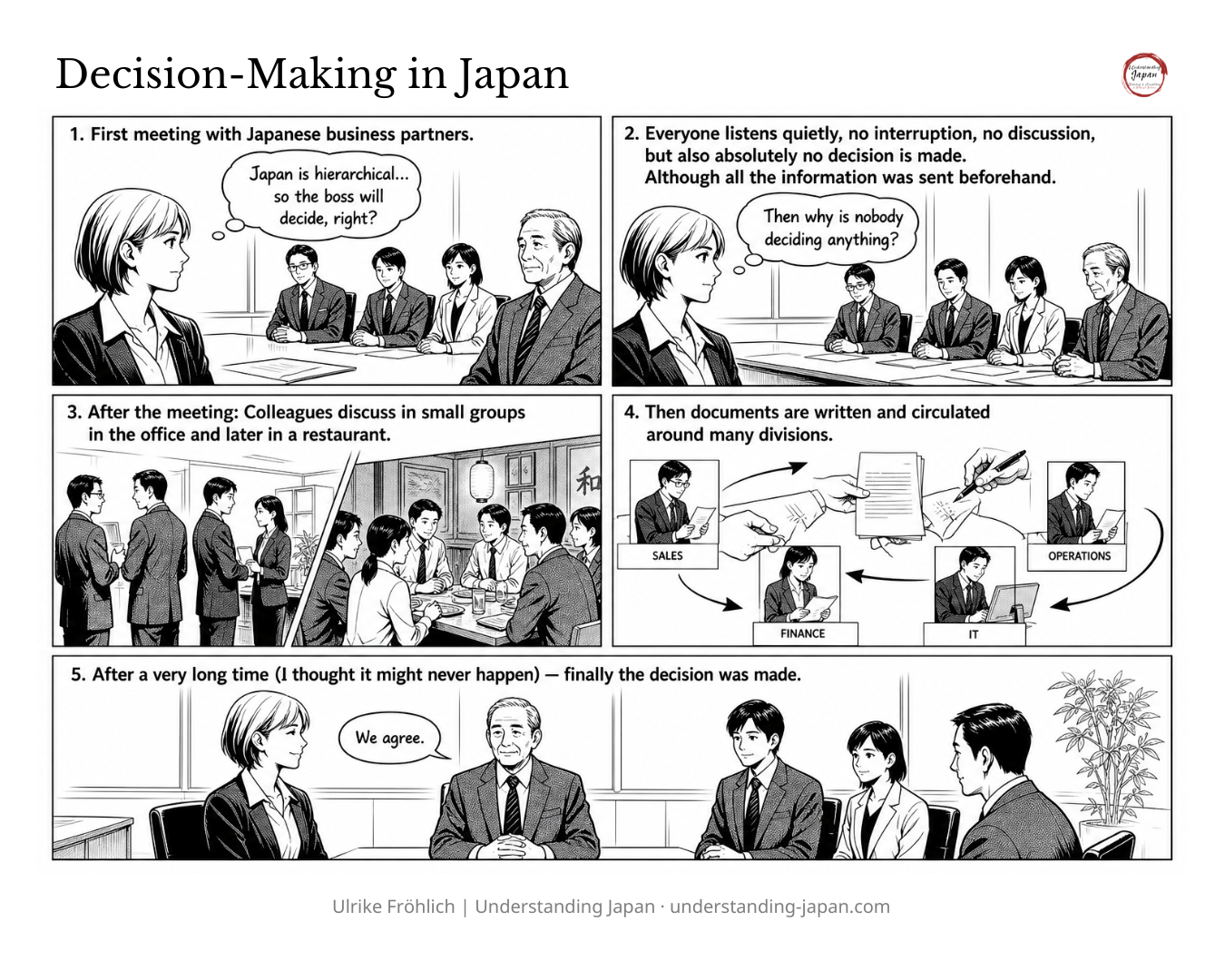
My first experience in meetings with Japanese colleagues:
” Everyone was very quiet. Nobody interrupted the presentation. Hardly anyone asked questions during the meeting. There was a lot of silence… And even though all the information had been sent beforehand, no decision was made during the first meeting.”
If you have worked with Japanese companies before, this situation may sound familiar.
For many European teams, decision-making in Japan can feel confusing, frustrating, or surprisingly slow. Meetings often appear calm and harmonious. There may be little open disagreement, few direct questions, and no visible conflict. Yet after the meeting, it is often unclear whether any real decision has been made.
Especially for German or European professionals who are used to direct discussions and fast visible outcomes, this can create uncertainty:
- Who is actually making the decision?
- Why does everything take so long?
- Why was all the information requested beforehand if nobody decides during the meeting?
At first glance, Japanese companies often appear highly hierarchical. Many foreign professionals therefore assume that decisions are made quickly by senior management at the top.
But in reality, the process is usually far more collective.
What Happens Behind the Scenes
In many Japanese organizations, important decisions are not primarily made during the meeting itself.
Instead, meetings are often part of a much larger alignment process happening quietly in the background.
Before a formal decision is finalized, many stakeholders may already have been consulted informally:
- colleagues
- departments
- specialists
- middle management
- senior leaders
Concerns are discussed privately. Risks are identified early. Potential resistance is addressed before a proposal officially moves forward.
This process is commonly known as nemawashi.
The word originally comes from gardening and literally refers to “preparing the roots” before transplanting a tree. In business, it means carefully laying the groundwork before a formal decision is made.
For European teams, this can sometimes feel invisible.
The official meeting may therefore seem surprisingly uneventful because much of the real discussion has already happened beforehand — or will happen afterwards in smaller conversations.
Why Silence Does Not Mean Disagreement
One of the biggest misunderstandings in Japan-related projects is the interpretation of silence.
In many European business cultures, active discussion is often associated with engagement, transparency, and progress. Open debate can signal efficiency and professionalism.
In Japan, however, openly challenging others in a meeting may create discomfort or disrupt group harmony.
As a result:
- concerns are often expressed indirectly
- disagreement may remain subtle
- discussions continue outside the formal meeting room
This does not mean people are disengaged.
Quite the opposite.
It often means participants are thinking carefully about implications, responsibilities, risks, and internal alignment.
The Ringi Process
Once a proposal has been informally aligned, many organizations move into a more formal approval process called ringi.
A written proposal — often called a ringi-sho — circulates through different departments and management levels for review and approval.
Each stakeholder reviews the document, adds comments if necessary, and formally acknowledges agreement.
From a European perspective, this can seem bureaucratic or time-consuming.
However, the goal is not speed alone.
The process aims to create:
- broad internal support
- shared responsibility
- fewer surprises during implementation
- smoother execution later
And this is an important point:
While Japanese decision-making may sometimes appear slow at the beginning, implementation afterwards is often remarkably fast and coordinated because so much alignment has already taken place.
Why This Matters in International Projects
Many Europe–Japan projects do not fail because of technical problems or lack of expertise.
They struggle because both sides interpret the same situation differently.
European teams may perceive hesitation or inefficiency.
Japanese teams may perceive pressure for premature decisions before sufficient alignment has been achieved.
Understanding these different expectations can significantly improve collaboration, especially in:
- international projects
- negotiations
- strategy discussions
- headquarters–subsidiary communication
- change management
- virtual collaboration
Final Thought
In many Western business environments, speed is often seen as a sign of competence.
In Japan, however, the focus is frequently on reducing future friction by building alignment first.
Or put differently:
The meeting is not always where the decision is made.
Sometimes, it is where the decision becomes visible.
Have you experienced similar situations in Japanese business environments?
What differences in decision-making surprised you most?
Related Learning Experiences
If you would like to explore more, discover our eLearnings:
Explore Negotiation Success in Japan – An Interactive Story to experience how Japanese decision-making influence negotiations in practice.
Want to better understand what happens in Japanese meetings?
Explore Meeting Culture in Japan & Germany – Understanding Processes and Navigating Differences.
Communication in Japanese meetings is often subtle and indirect.
In Communication Pitfalls in Meetings, you can explore common misunderstandings and hidden signals in intercultural business communication.

