

By Ulrike Fröhlich
I thought the cooking class would never happen.
It was during my time working for the Prefectural Government of Nagano, shortly after the 1998 Winter Olympics. We wanted to organize a cooking class for the volunteers who had given so much of their time during the Games — a small gesture of appreciation, something warm and celebratory.
From a German perspective, this felt simple. Book a venue, find a teacher, set a date, send invitations. Done.
What followed was weeks of quiet meetings, informal conversations, consultations across departments, and what felt like endless deliberation — over a cooking class. I found myself thinking: Will this ever actually happen?
It did. And it was wonderful.
But more importantly — it taught me something I would only fully understand years later, working with Toshiba in Germany.
The Meeting Is Not Where the Decision Happens
In Japanese organizations, decisions are rarely made in the room where everyone is sitting.
Before a formal proposal moves forward, something else happens first: nemawashi — a word that literally comes from gardening, meaning “preparing the roots.” Informally, quietly, relevant people are consulted. Concerns are raised and addressed. Potential resistance is identified before it becomes a problem.
The cooking class in Nagano? It wasn’t just a cooking class. It involved budget approvals, coordination between departments, questions of fairness — which volunteers, from which districts — and alignment with senior officials. Each of those conversations happened one-on-one, in hallways, over tea, long before anyone sat down together formally.
At the time, I found it frustrating. Looking back, I understand exactly why it had to happen that way.
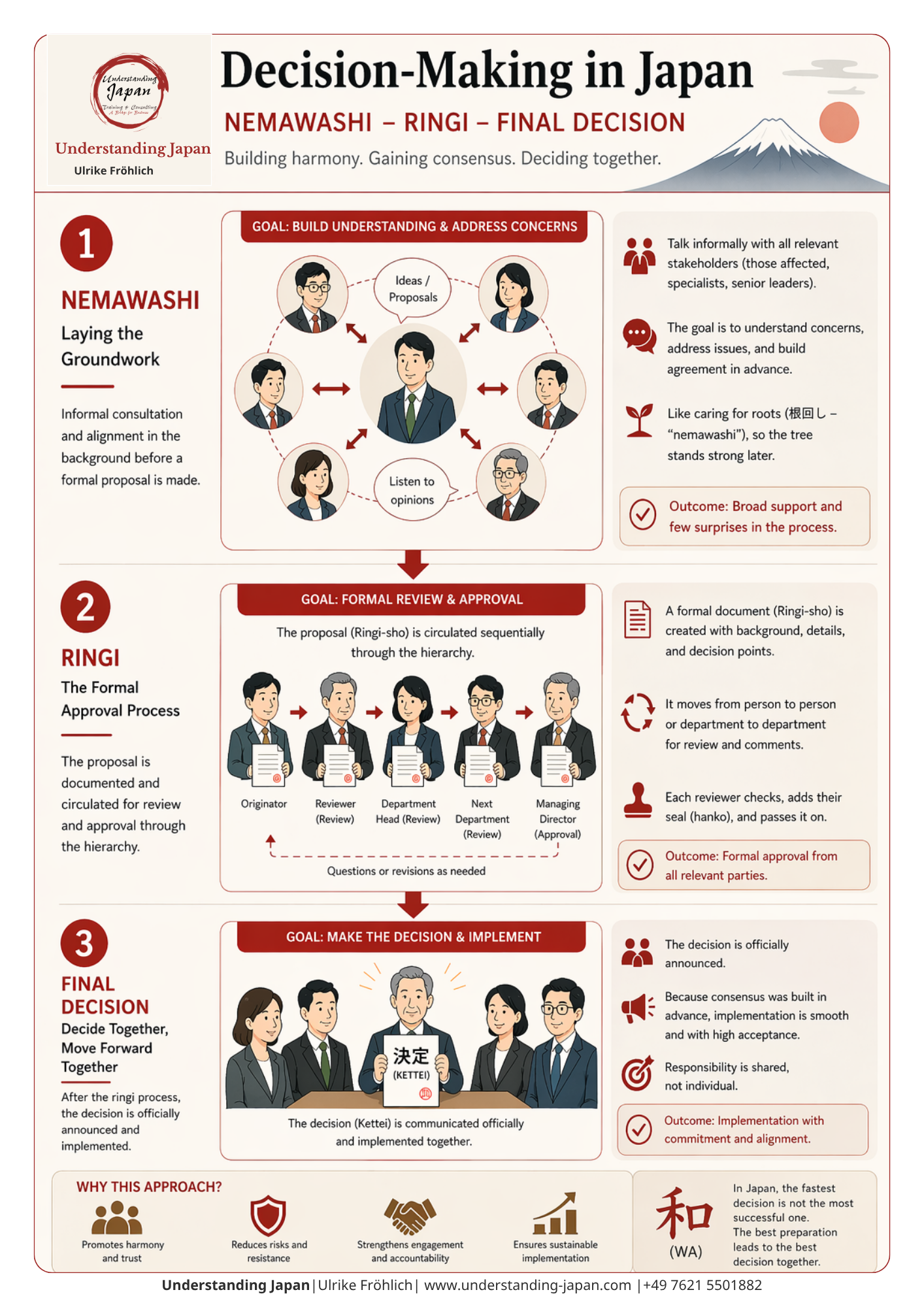
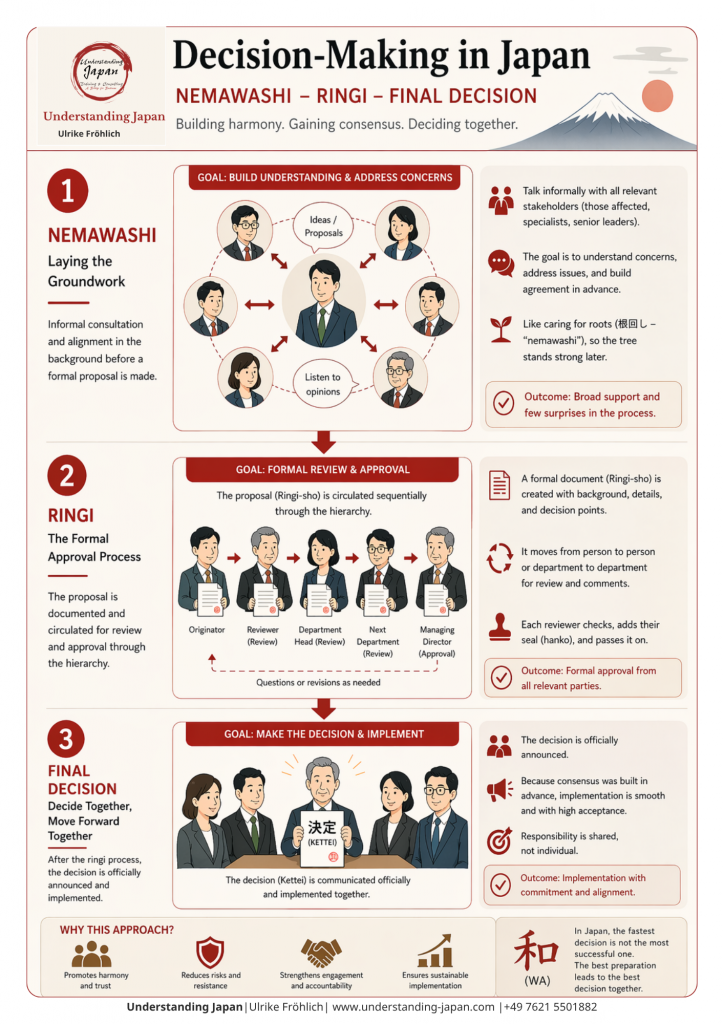
Step 1: Nemawashi – Laying the Groundwork
Nemawashi is the informal consultation and alignment process that takes place before a formal proposal is ever officially made.
It involves talking with all relevant stakeholders — those affected by the decision, technical specialists, middle management, and senior leaders — not in a formal meeting, but in smaller, quieter conversations. The goal is to understand concerns early, address issues before they escalate, and build agreement in advance.
Think of it like caring for the roots of a tree before transplanting it. The preparation is invisible. But without it, the tree won’t survive the move.
Outcome: Broad support and few surprises in the process.
Step 2: Ringi – The Formal Approval Process
Once a proposal has been informally aligned, it enters the ringi process — a formal, documented approval flow.
A written proposal, the ringi-sho, is created with background information, details, and decision points. It then circulates sequentially through the hierarchy: from the originator to reviewers, department heads, adjacent departments, and finally to the managing director for approval. Each person reviews the document, may add comments, and formally acknowledges agreement — traditionally with a personal seal, the hanko.
From a European perspective, this can feel bureaucratic. But the goal is not speed alone. It is to create formal approval from all relevant parties, shared responsibility, and a clear record of the decision.
Outcome: Formal approval from all relevant parties.
Step 3: Final Decision – Decide Together, Move Forward Together
After the ringi process, the decision — kettei — is officially announced and implemented.
And here is what surprised me most during my time at Toshiba: once the decision was made, things moved fast.
Implementation was smooth, committed, and remarkably well-coordinated. There was no quiet resistance, no one who felt overruled, no “I never agreed to this.” Because in a very real sense, everyone already had.
What had once felt slow and opaque to me now felt deeply democratic. Everyone had been consulted. Everyone had a voice — not in a loud, open debate, but through the careful, layered process of nemawashi and ringi.
Outcome: Implementation with commitment and alignment.
Why This Matters for International Teams
Many Europe–Japan projects don’t fail because of technical problems or lack of expertise. They struggle because both sides interpret the same situation differently.
European teams may perceive hesitation or inefficiency. Japanese teams may experience pressure to make premature decisions before sufficient internal alignment has been achieved.
A few things worth keeping in mind:
- Asking for a fast decision may backfire. If the internal alignment process hasn’t happened yet, pushing for a quick answer may result in a “yes” that doesn’t actually move forward — or a delay while nemawashi quietly takes place anyway.
- The first meeting is rarely the decision meeting. Think of it as the beginning of a process, not the moment of conclusion.
And perhaps most importantly: in Japanese business culture, the goal is not efficiency in the moment. It is resilience over time.
A Different Kind of Speed
In many Western business environments, speed is seen as a sign of competence. Decisions should be fast, discussions direct, and outcomes immediate.
In Japan, the focus is frequently on reducing future friction by building alignment first.
Or put differently:
In Japan, the fastest decision is not the most successful one. The best preparation leads to the best decision together.
That cooking class in Nagano? It brought together volunteers from across the prefecture. The food was prepared with great care. The atmosphere was warm and full of gratitude.
It took longer than I expected. But looking back — it was exactly right.
Want to Go Deeper?
If you’d like to experience how Japanese decision-making plays out in real negotiations and meetings, explore the Japan Academy:
Negotiation Success in Japan (available in English & German) — an interactive story that puts you in the middle of a Japan negotiation and lets you experience the decision-making process firsthand.
Meeting Culture in Japan & Germany — understand what really happens before, during, and after Japanese meetings, and how to navigate the differences effectively.


Pingback: Types of Japanese Group Discussions: A Cultural Guide
Thank you for referencing my article on Nemawashi and Japanese decision-making.
I really enjoyed reading your article.
Ulrike Froehlich