

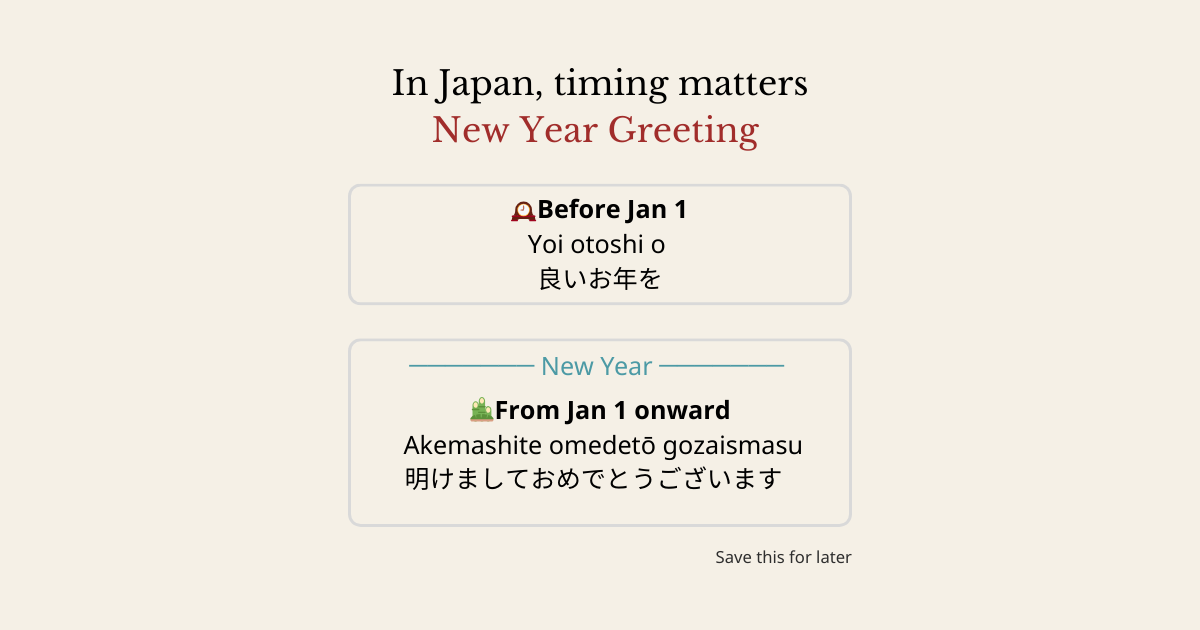
“Akemashite Omedetō” or “Yoi Otoshi o“?
What to Say When in Japanese Business — and Why It Matters
The turn of the year is a special moment in Japanese business culture. Final emails in December, last meetings before the holidays, and the first messages in January all follow well-established conventions.
Two Japanese New Year greetings often cause confusion for international professionals:
良いお年を (yoi otoshi o)
and
明けましておめでとうございます (akemashite omedetō gozaimasu)
At first glance, both may seem to mean “Happy New Year.” In reality, they are used at very different moments — and choosing the right one signals cultural awareness and respect.
Yoi Otoshi o — The Greeting Before the New Year
Yoi otoshi o is used before January 1st. Typical situations include:
- the last meeting of the year
- a final email before the holidays
- saying goodbye to colleagues or business partners in December
Its meaning is closer to: “I wish you a good year ahead.”
In Japan, this is not a casual phrase. It marks a clear and respectful closure of the business year.
By using it, you communicate:
- that the current phase is coming to an end
- that transitions deserve attention
- that the upcoming year is approached with intention
In Japanese business culture, time is structured, and endings matter just as much as beginnings.
Akemashite Omedetō Gozaimasu — The Greeting After New Year
Akemashite omedetō gozaimasu is used from January 1st onward. Literally, it means something like:
“Congratulations on the opening of the new year.”
In professional contexts, the formal version with “gozaimasu” is standard — even with long-standing contacts. This greeting reflects:
- a conscious new start
- respect for the symbolic importance of the New Year
- appreciation of the ongoing business relationship
Using this phrase too early (in December) feels out of place in Japan, because the New Year represents a clear reset, not a gradual transition.
Why This Distinction Matters in Business
Many international professionals assume: “It’s just a greeting — getting it wrong can’t be that serious.”
And they are right — no business deal fails because of a misplaced New Year’s wish.
But the right wording at the right time sends subtle yet powerful signals:
- cultural sensitivity
- attention to unspoken rules
- reliability as a business partner
In Japanese business culture, trust is often built not through grand statements, but through many small, consistent signals of respect.
Small Phrases, Big Impact
Whether it is yoi otoshi o or akemashite omedetō gozaimasu, these expressions show that communication in Japan is more than exchanging information. It structures relationships, marks transitions, and creates clarity. Understanding these nuances helps you communicate not only correctly — but on equal footing.
Want to Practice These Nuances in Context?
If you would like to explore Japanese business communication in a more interactive way,
my Osaka Challenge offers a playful, scenario-based introduction to everyday Japanese expressions, cultural signals, and typical business situations.
It is designed for professionals who want to experience how small details shape communication — not just read about them.
👉 You can find the Osaka Challenge here:
Osaka Challenge in English
Osaka Challenge auf Deutsch

